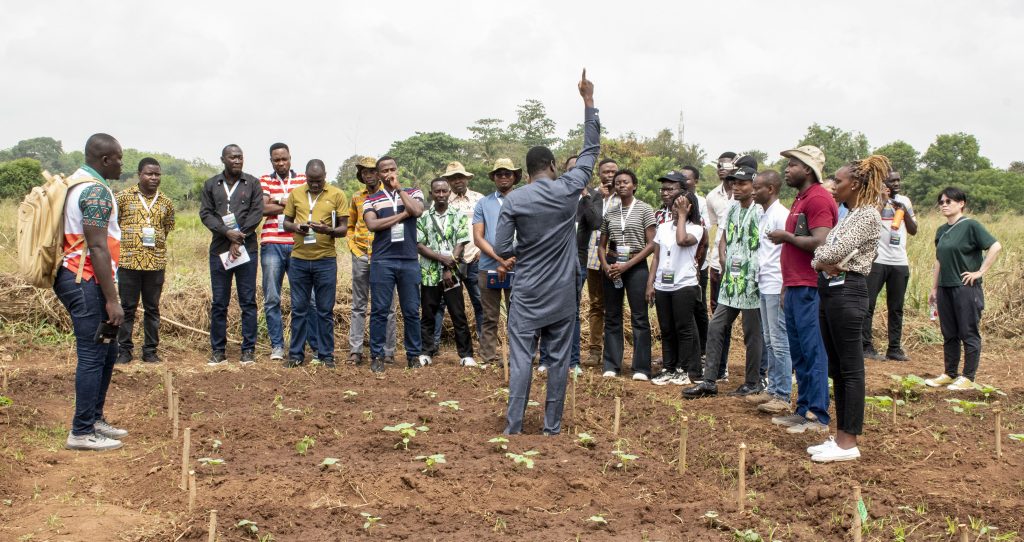
From February 16 to 20, 2026, the Genetics, Biotechnology and Seed Science Unit (GBioS) hosted an impactful workshop in Cotonou, Benin focussing on drone‑based phenotyping for amaranth and okra. The VACS Amaranth and Okra Phenotyping by Drones Workshop brought together researchers, graduate students, agronomists, and agricultural practitioners to explore how unmanned aerial vehicles (UAVs), commonly known as drones, can help accelerate data collection and crop evaluation in modern agriculture.
The workshop was designed with a clear objective: to train participants in the use of drone technology to collect efficient, accurate, and high‑quality agricultural data, particularly for phenotyping and assessing responses of the crop to biotic and abiotic stress.
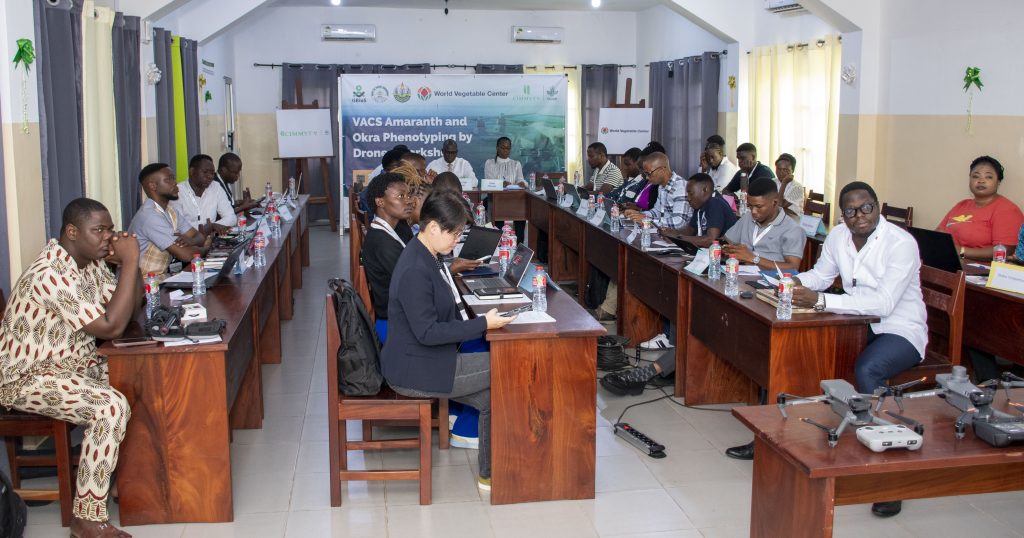
Understanding Drone Phenotyping in Agriculture
Drone‑based phenotyping refers to the use of UAVs equipped with specialized sensors to capture images and data across agricultural fields. Unlike traditional field measurements _ which can be slow, labor‑intensive, and prone to human error, drones offer a rapid, high‑resolution, and non‑destructive way to monitor crops over time and across large areas.
Modern agricultural drones can be fitted with a range of sensors, including RGB, multispectral, hyperspectral, and thermal cameras, that capture different aspects of plant performance. These sensors help researchers and farmers measure traits such as leaf area, plant height, chlorophyll content, and stress indicators through indices that are essential for crop management, breeding programs, and precision agriculture strategies.
The Importance of Drones in Agriculture
Drones play a critical role in modern agriculture by enabling rapid, large-scale, and precise data collection across fields, allowing farmers and researchers to monitor crop growth, detect stress, disease, or nutrient deficiencies early, and make informed management decisions. Equipped with high-resolution and multispectral sensors, drones support precision agriculture practices, optimize resource use, reduce labor costs, and enhance safety, while also facilitating high-throughput phenotyping for crop breeding programs. By providing timely, accurate, and actionable information, drones contribute to increased productivity, sustainable farming, and improved food security.
Comprehensive Workshop Curriculum
The workshop curriculum was designed to blend foundational theory with hands‑on practice.
Key topics included :
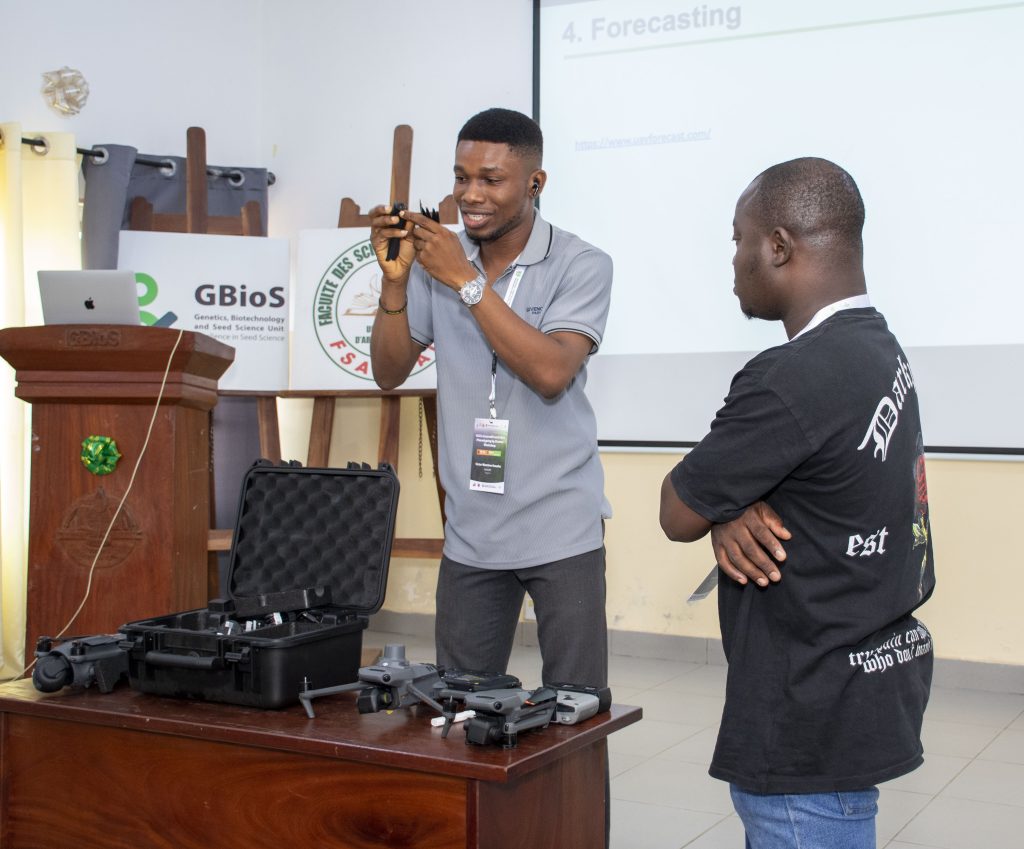
- Drone Basics: Understanding types of drones, key components, and appropriate configurations for agricultural phenotyping.
- Regulations and Safety: Navigating local and international drone regulations, legal requirements, and ethical considerations.
- High‑Throughput Phenotyping (HTP): An introduction to high‑throughput phenotyping, a methodology that allows for rapid acquisition of large amounts of trait data across many plants or plots and the ways drones facilitate this process.
- Flight Planning and Execution: Practical sessions on mission planning, pre‑flight safety checks, and executing field surveys.
- Image Processing: Learning how to process aerial images to create orthomosaics and other usable data products, including vegetation indices.
- Data Analysis: Converting drone imagery into meaningful agricultural insights through analysis tools and software.
The inclusion of image processing and data analysis modules was especially emphasized, as these are critical steps in transforming drone‑captured imagery into actionable phenotypic data that researchers can use to assess plant performance.
Why Drone Technology Matters
Drone technology is reshaping agricultural research and practice in several ways:
– Rapid Data Collection Drones can cover large areas much faster than manual scouting, offering frequent and consistent views of crop development throughout the growing season.
– High‑Resolution Imagery UAVs provide high spatial and temporal resolution, enabling detailed crop monitoring that surpasses what’s available from satellite imagery or manned aircraft.
– Low Costs and Sustainability Although drones require upfront investment, their operation is generally cost‑effective over time and reduces the need for manual fieldwork.
– Improved Precision Agriculture High‑throughput phenotyping allows farmers and researchers to identify stress, disease, and nutritional deficiencies early _ often before symptoms are visible to the naked eye enabling more targeted management decisions.
Hands‑On Experience and Participant Engagement
During the workshop, participants engaged in real field flights, applying their training in mission planning and image acquisition. Practical exercises involved flying drones over amaranth and okra test plots, capturing images, and using specialized software to process and analyze the data.
The training emphasized both technological skills and scientific interpretation _ equipping attendees not just to gather data, but to meaningfully interpret it for research and decision‑making. These skills are especially valuable for plant breeding, crop management, and agronomic research as they enable high‑throughput phenotyping, which dramatically speeds up the evaluation of plant traits compared to traditional manual measurements.

Workshop Impact and Future Directions
By the end of the workshop, participants had developed a solid foundation in using drones for field phenotyping and data collection _ a skillset that can directly support agricultural research initiatives and enhance productivity in the field. The training not only improved technical proficiency but also fostered a spirit of innovation among agricultural professionals in the region.
As drone technology continues to evolve, combining lightweight UAV hardware with advanced sensors and powerful image analytics, its potential for transforming agriculture from breeding programs to precision farming will only grow. Educational efforts like the VACS Workshop help ensure that researchers and practitioners are prepared to leverage these tools effectively for sustainable agriculture and food security.