Shango, A. J., Omondi, E. O., N’Danikou, S., Tchokponhoué, D. A., Schranz, M. E., Rabary, B., Kabululu, M. S., Gumedze, T., Achigan-Dako, E. G., Venkataramana, P., Philipo, M. L., & vanZonneveld, M. (2026). Genetic diversity and population structure of jute mallow (Corchorus olitorius L.) global collection to guide conservation and breeding. The Plant Genome, 19, e70252. https://doi.org/10.1002/tpg2.70252
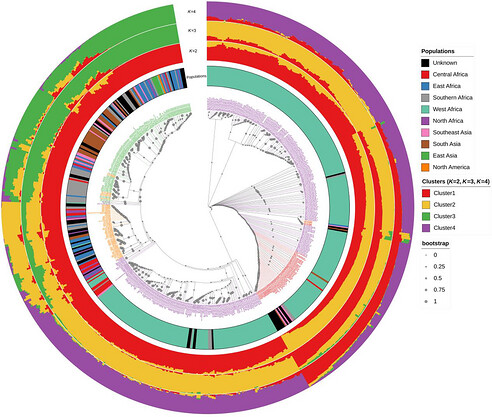
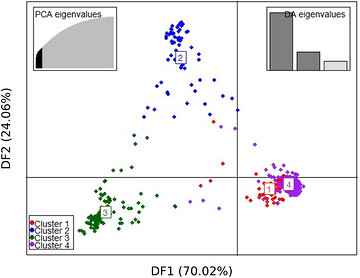
Understanding the genome-wide diversity of jute mallow (Corchorus olitorius L.) is crucial for unlocking the potential of global genebank collections, enabling the discovery and use of traits that support climate resilience, improve nutrition, and increase productivity. Using 23,471 high-quality diversity array technology sequencing single-nucleotide polymorphisms (SNPs), this study assessed the genetic diversity, population structure, and linkage disequilibrium (LD) of 607 accessions. Moderate genetic diversity was detected with a total gene diversity of 0.28, an expected heterozygosity of 0.26, and a Shannon index of 0.42. Four distinct genetic clusters were identified, reflecting geographic patterns, where Cluster 1 (n = 62) and Cluster 4 (n = 354) were predominantly composed of West African accessions. An analysis of molecular variance revealed significant genetic structuring (p < 0.001), with most genetic variation occurring within countries (45.2%), followed by within individuals (32.5%), while differentiation among clusters accounted for 18.2% and variation among regions was minimal (2.9%). LD revealed low genome-wide r2 values (mean = 0.028; r290 = 0.067) and a very rapid decay (LD50 ≈ 1 bp), with only 4.2% of SNP pairs showing significant LD (r2 > 0.1, p < 0.05), indicating extensive historical recombination. The findings suggest that a significant portion of the existing genetic variation remains untapped in breeding. Strategic conservation of the unique genetic variants through core and mini-core collections, coupled with targeted crosses among diverse regional accessions, can broaden the genetic base and support the development of resilient, high-yielding, and nutrient-rich dual-purpose varieties (i.e., leafy vegetables and industrial fibers) across diverse environments.