Adegolou, F.A.L., Sikirou, R., Agoligan, F.V.P., Dossoumou, M.E., Houdegbe, A.C., Tchokponhoue, D.A., Schafleitner, R. and Achigan-Dako, E.G. (2026). First Report of Choanephora cucurbitarum Causing Wet Rot on Amaranth (Amaranthus cruentus) in Benin. New Disease Reports, 54, e70146. https://doi.org/10.1002/ndr2.70146
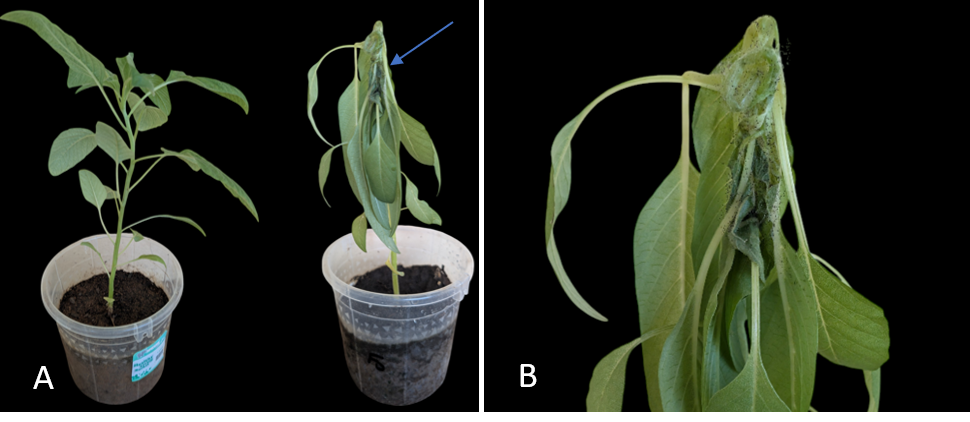
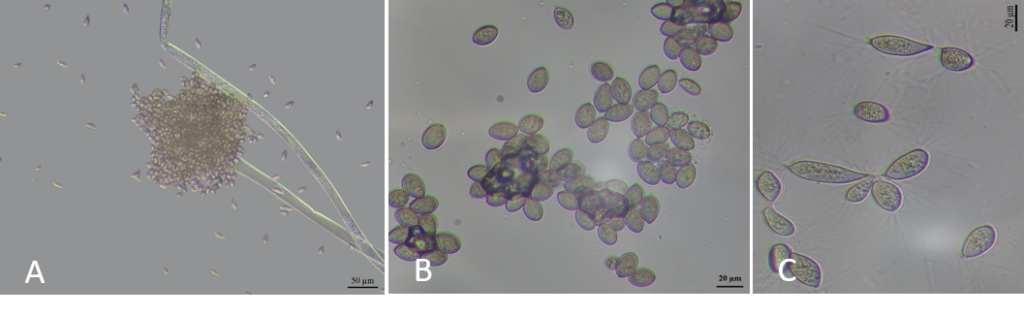
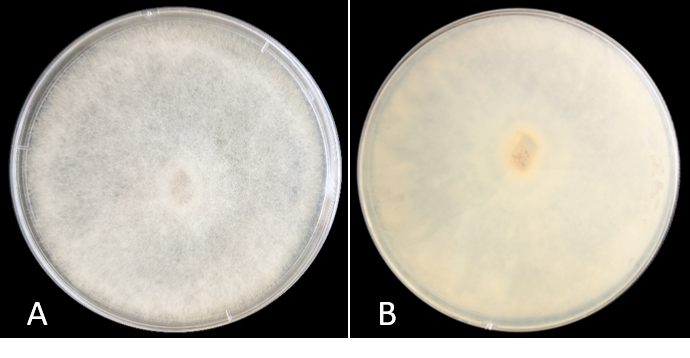
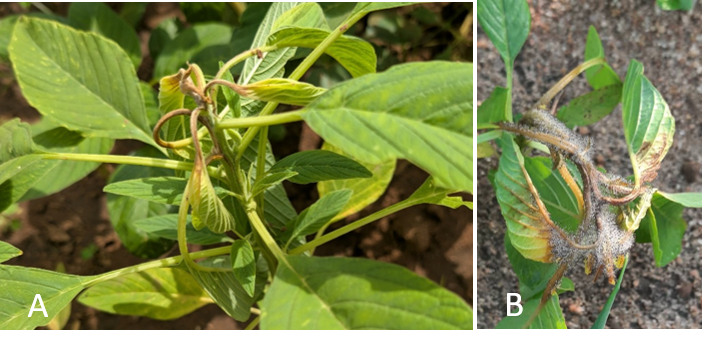
Amaranth (Amaranthus spp.; Amaranthaceae) is a dual-purpose crop, valued both as a leafy vegetable and a pseudocereal. Wet rot symptoms have been observed in amaranth production fields in Benin for several years. In September 2025, a survey of amaranth production fields covering approximately 1.2 ha in Togba, southern Benin, revealed severe wet rot on Amaranthus cruentus plants, with an incidence of about 40%. Infected plants showed brown to black, water-soaked lesions starting at the apex and spreading down the stem. A total of 12 diseased stem samples were collected in Togba, Abomey-Calavi, Benin. The pathogen was isolated on potato dextrose agar (PDA), and its morphology was then examined and described.
Sequencing of the internal transcribed spacer (ITS), large subunit 28S rRNA gene (LSU), and translation elongation factor 1-alpha (EF-1α) regions from isolate GBioS_CHC01 (GenBank Nos. PZ440532, PZ440690, PZ444246) confirmed its identity as Choanephora cucurbitarum, sharing >99.4% sequence identity with reference strains in a BLAST (Basic Local Alignment Search Tool) search. A Phylogenetic tree constructed using MEGA 12 placed the isolate within a well-supported C. cucurbitarum clade (97% bootstrap support). A pathogenicity test confirmed the pathogen’s ability to reproduce the disease symptoms on healthy plants; the pathogen was then re-isolated and morphologically confirmed, fulfilling Koch’s postulates. To our knowledge, this is the first confirmed report of Choanephora cucurbitarum causing wet rot on amaranth in Benin.