Determinants of farmers’ willingness to adopt technologies for the agroecological and precision management of potato pests and diseases in Rwanda

Ganta J.S.O., Karangwa A., Bamurigire P., Fassinou Hotegni N.V., Achigan-Dako E.G. and de Paul Bigirimana V., (2026) Determinants of farmers’ willingness to adopt technologies for the agroecological and precision management of potato pests and diseases in Rwanda. Front. Sustain. Food Syst. 10:1930171.  https://doi.org/10.3389/fsufs.2026.1930171

Potato (Solanum tuberosum L.) production in Rwanda is limited by pests and diseases, resulting in significant yield losses and increased use of synthetic pesticides. Despite growing interest in sustainable agriculture, few studies provide empirical evidence on farmers’ knowledge of agroecological pest management practices and precision agriculture in Rwanda. This study assessed farmers’ management practices, awareness and perceptions of agroecological practices and precision agriculture technologies, as well as factors that may influence the willingness to adopt precision agriculture tools in smallholder potato systems.

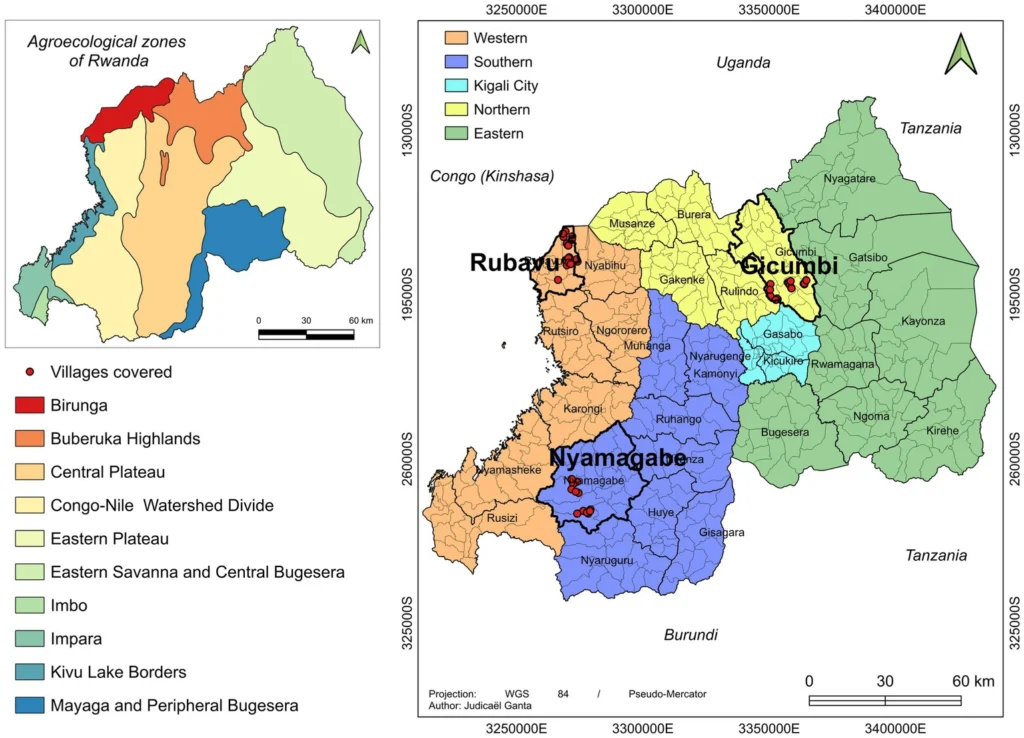
A farm household survey using a semi-structured questionnaire was conducted among 223 potato farmers in three districts of Rwanda (i.e., Rubavu, Gicumbi, and Nyamagabe) in July 2025. Descriptive statistics, Chi square tests, and Fisher’s exact tests were used to analyze farmers’ practices and perceptions. A Firth-penalized logistic regression model, constructed based on a purposeful selection of covariates strategy, was used to identify factors associated with farmers’ willingness to adopt precision agriculture technologies.

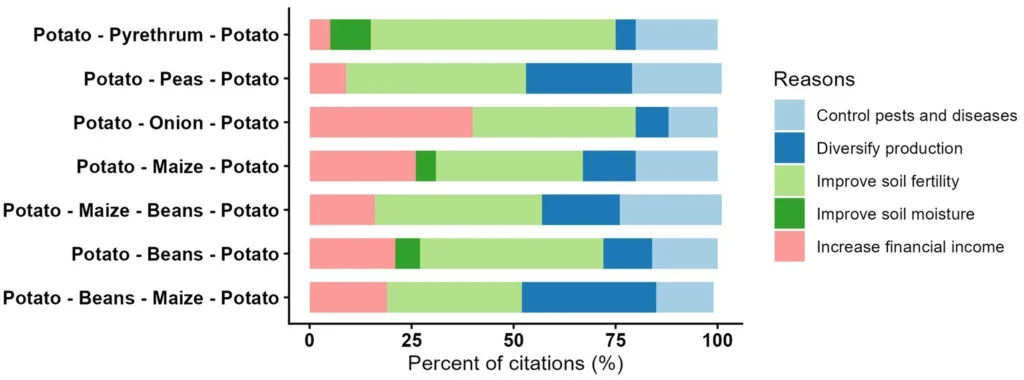
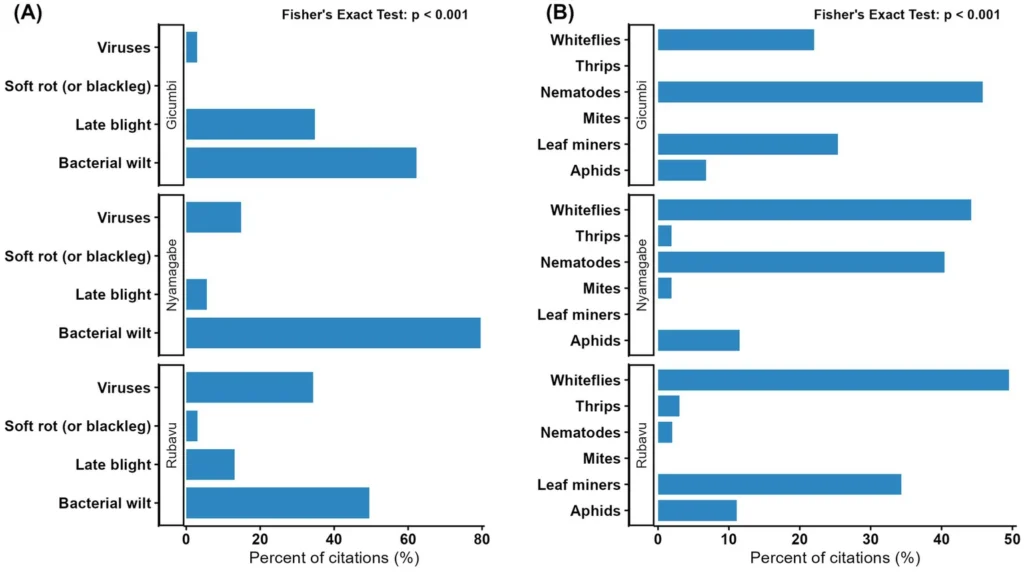
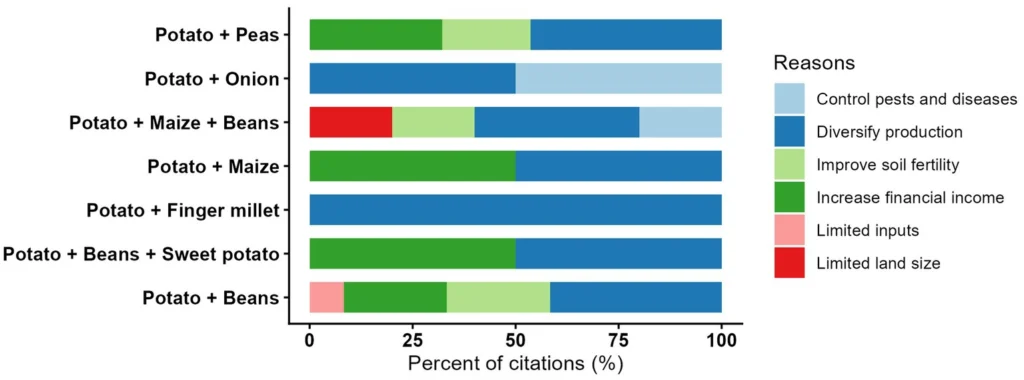
Findings revealed that pests and diseases were the main production constraints, with bacterial wilt, viruses, late blight, and whiteflies being the most frequently cited. Farmers primarily used synthetic pesticides to manage aerial pests and foliar diseases, while preventive agronomic practices were used to manage soil-borne pests and diseases. The use of biopesticides remained extremely limited and farmers were aware of the negative impacts of pesticide misuse and expressed a strong willingness to adopt better pest management practices. Knowledge of precision agriculture technologies was mainly limited (79%). Farmers associated precision agriculture primarily with mechanization, whereas awareness of drones, sensors and digital decision-support tools was limited. They demonstrated highly positive perceptions toward precision agriculture (90%) and a strong willingness to learn more (87%). The results of the logistic regression showed that mobile phone usage (OR = 20.58, p < 0.01) and the willingness to adopt agroecological practices (OR = 67.73, p < 0.001) were associated with a higher likelihood of expressing willingness to adopt precision agriculture technologies.

These results highlight the opportunity to integrate precision agroecology approaches in Rwanda. Mobile-based advisory systems and low-cost digital technologies could serve as effective entry points for promoting sustainable potato production systems among smallholder farmers.
Privacy Policy

Introduction:

At GBioS, accessible from [https://gbios-uac.org](https://gbios-uac.org), the privacy of our visitors is one of our main priorities. This privacy policy document contains types of information that are collected and recorded by GBioS and how we use it.

Consent:

By using our website, you hereby consent to our privacy policy and agree to its terms.

Information Collection:

We collect several different types of information for various purposes to provide and improve our service to you.

Types of Data Collected:

– Personal Data: While using our service, we may ask you to provide us with certain personally identifiable information that can be used to contact or identify you.

– Usage Data: We may also collect information on how the service is accessed and used. This usage data may include information such as your computer’s Internet Protocol address, browser type, browser version, the pages of our service that you visit, the time and date of your visit, the time spent on those pages, and other diagnostic data.

Use of Data:

GBioS uses the collected data for various purposes:

– To provide and maintain our service

– To notify you about changes to our service

– To allow you to participate in interactive features of our service when you choose to do so

– To provide customer support

– To gather analysis or valuable information so that we can improve our service

– To monitor the usage of our service

Data Security:

The security of your data is important to us, but please remember that no method of transmission over the Internet or method of electronic storage is 100% secure. Although we strive to use commercially acceptable means to protect your personal data, we cannot guarantee its absolute security.

Changes to this Privacy Policy:

We may update our privacy policy from time to time. We will notify you of any changes by posting the new privacy policy on this page.

Contact Us:

If you have any questions about this Privacy Policy, please contact us at contact@gbios-uac.org.

Legal Notice

Website Publisher :

The website [https://gbios-uac.org](https://gbios-uac.org) is published by GBioS, located at 01 BP 526 Cotonou, Republic of Benin.

Publication Director:

The Publication Director is [First Name Last Name], holding the position of [professional title], who can be contacted via email at [contact@gbios-uac.org] or by phone at [phone number].

Hosting:

This site is hosted by [Hosting Provider’s Name], located at [hosting provider’s full address], [city, postal code], [country]. Contact phone: [hosting provider’s phone number].

Intellectual Property:

This site and its content are protected under copyright and intellectual property laws. Any reproduction, in whole or in part, on any electronic medium or otherwise, is strictly forbidden without prior permission from the publication director.

Personal Data Protection:

In accordance with applicable laws, you have the right to access, modify, rectify, and delete personal data concerning you. To exercise these rights, please contact [email or postal address dedicated to data protection].

Cookies:

The site [https://gbios-uac.org](https://gbios-uac.org) uses cookies to enhance user experience and analyze traffic. Cookies are files stored on your computer that collect information about your navigation. Acceptance of cookies is necessary for some functionalities of the site.

Hyperlinks:

GBioS is not responsible for the content of external sites linked by hyperlinks. The use of these sites is at the user’s own risk.

Changes to Legal Notice:

GBioS may modify this legal notice at any time. Regular consultation is recommended.

Applicable Law:

This site is governed by the laws of Benin.

For any questions regarding this legal notice, contact [contact@gbios-uac.org](mailto:contact@gbios-uac.org).

Terms of Use

  1. Introduction

Welcome to [https://gbios-uac.org](https://gbios-uac.org) (hereinafter referred to as the « site »). By accessing our site, you agree to these terms of use and commit to abide by them. If you do not agree to these terms, please do not use the site.

  1. Use of the Site

The GBioS site is a space providing information on our research and development activities in genetics, biotechnology, and seed science. The content is for personal and non-commercial use only. Any commercial use is strictly prohibited without our prior written consent.

  1. Intellectual Property

All content published on the site, including texts, graphics, logos, images, and videos, is the property of GBioS or its partners and is protected by copyright law. No part of the site may be copied, reproduced, modified, or disseminated without the express permission of GBioS.

  1. Liability

GBioS strives to ensure the accuracy and updating of the information disseminated on the site but does not guarantee that this information is complete, precise, or up to date. GBioS cannot be held responsible for damages resulting from the use of the site.

  1. Changes to the ToU

GBioS reserves the right to modify these ToU at any time. Changes will take effect as soon as they are published on the site. It is your responsibility to regularly check the ToU to be aware of any changes.

  1. Applicable Law and Jurisdiction

These ToU are governed by the laws of the Republic of Benin. In the event of a dispute, the courts of the Republic of Benin will have exclusive jurisdiction.

Contact

For any questions or requests for information concerning the site, please contact us at [contact@gbios-uac.org](mailto:contact@gbios-uac.org).