Nyadanu D., Nunekpeku W., Tchokponhoue D. A., Lowor S. T., Pobee P., Anyomi W. E., Dogbatsey J. A., Yabani D. S., Asare P. A., Adu M. O., Nuclear DNA content and ploidy variation in Ghanaian accessions of kola [Cola nitida (Vent.) Schott & Endl.]: flow cytometry evidence from a national germplasm collection. Genet Resour Crop Evol 73, 286 (2026). https://doi.org/10.1007/s10722-026-02922-5
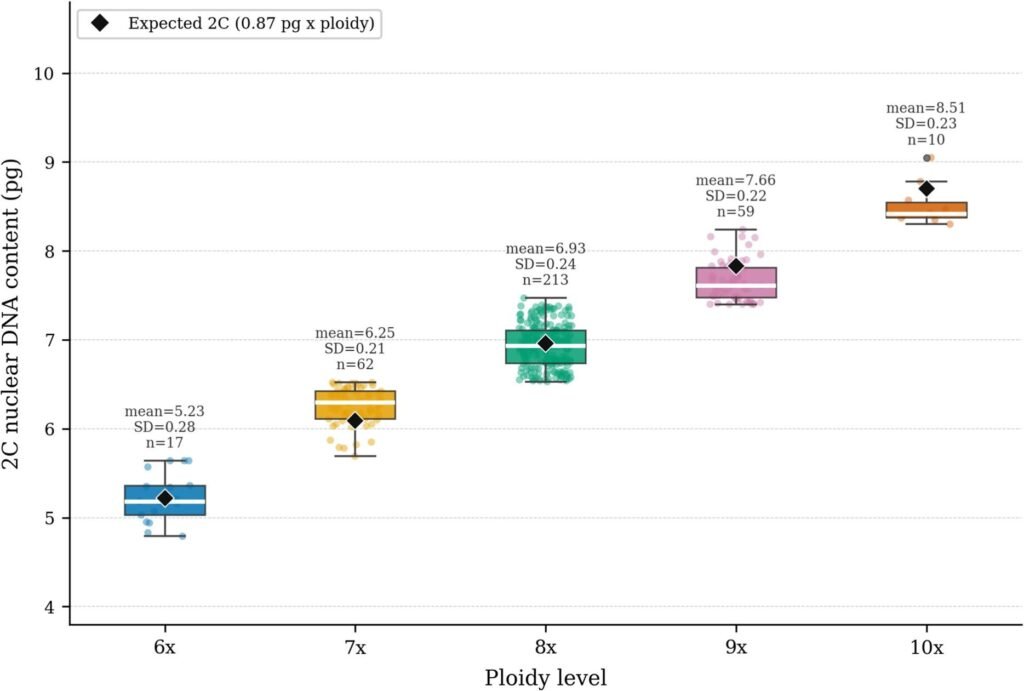
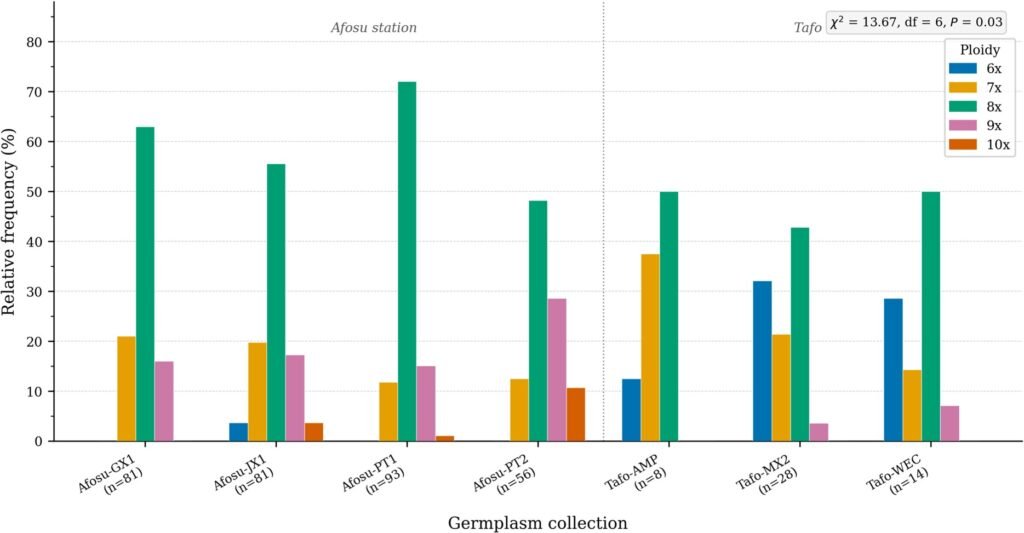
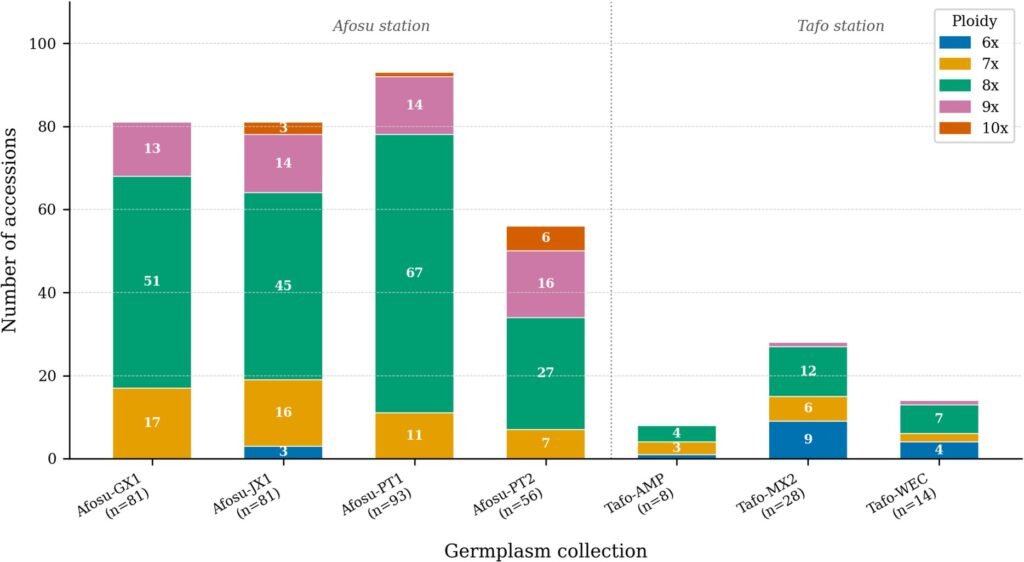
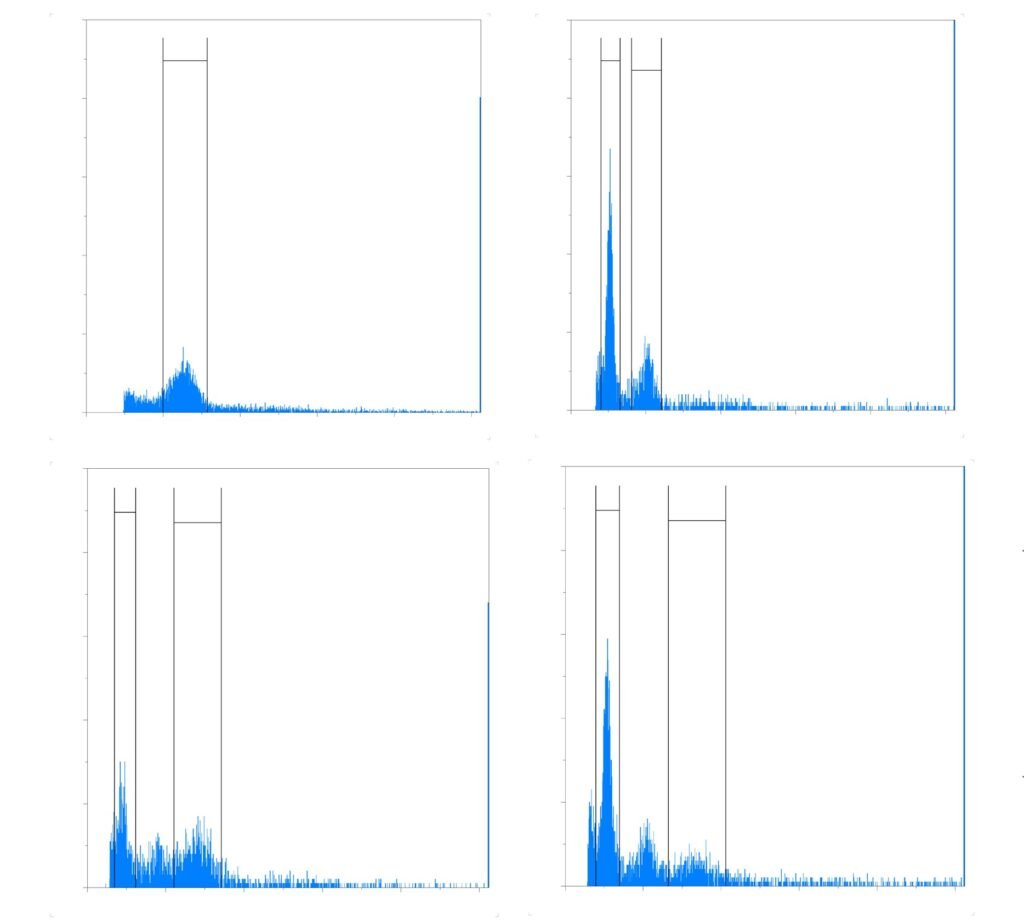
Kola (Cola nitida (Vent.) Schott & Endl.) is an economically and culturally significant tree crop of West and Central Africa, valued for its stimulant-rich nuts and increasingly recognised for nutraceutical potential. Sustained improvement efforts at the Cocoa Research Institute of Ghana (CRIG) have been frustrated by chronic cross-incompatibility, a constraint whose cytogenetic basis had never been investigated. We applied flow cytometry, using Sorghum bicolor (2C = 1.74 pg) as an internal standard, to determine the nuclear DNA content and infer ploidy levels of 361 C. nitida accessions from seven CRIG germplasm collections. Nuclear 2C DNA values ranged from 4.80 to 9.05 pg, corresponding to a 2C range of 4.69 to 8.85 × 10⁹ bp. Five DNA-content classes, provisionally interpreted as ploidy levels pending chromosome confirmation, were resolved: hexaploid (6x), heptaploid (7x), octoploid (8x), nonaploid (9x), and decaploid (10x). Octoploids dominated the collection (59.0%; χ2 = 466.43, df = 4, P < 0.001), but their frequency differed significantly across collections (χ2 = 13.67, df = 6, P = 0.03). Hexaploids were concentrated in the Tafo collections (14 of 17), with the remaining three in the Afosu-JX1 collection; decaploids occurred only in the Afosu collection. A significant positive association was detected between ploidy level and collecting-site altitude. With a mean 2C DNA content of 6.89 ± 0.15 pg, this study delivers the first estimate of the C. nitida nuclear genome size at approximately 848 Mbp per monoploid complement on the octoploid interpretation of the modal class, larger than the sequenced genomes of cacao and jute, though substantially smaller than that of allotetraploid cotton. These findings provide a first cytological framework for planning crosses in kola and generate the testable hypothesis that ploidy mismatch contributes to the self- and cross-incompatibility that has frustrated kola improvement.