Genetic diversity and population structure of jute mallow (Corchorus olitorius L.) global collection to guide conservation and breeding

Shango, A. J., Omondi, E. O., N’Danikou, S., Tchokponhoué, D. A., Schranz, M. E., Rabary, B., Kabululu, M. S., Gumedze, T., Achigan-Dako, E. G., Venkataramana, P., Philipo, M. L., & vanZonneveld, M. (2026). Genetic diversity and population structure of jute mallow (Corchorus olitorius L.) global collection to guide conservation and breeding. The Plant Genome, 19, e70252. https://doi.org/10.1002/tpg2.70252

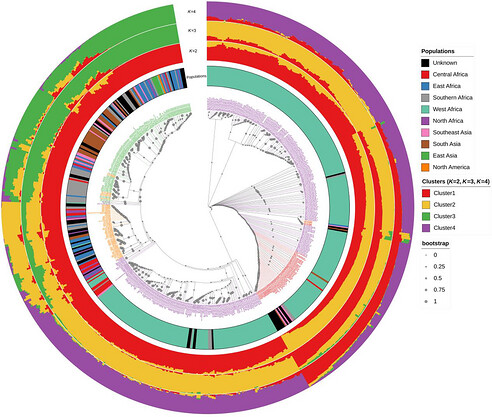
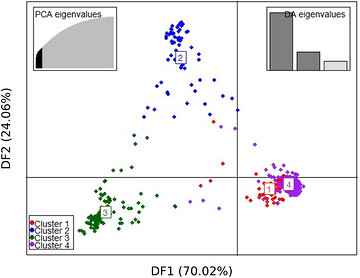
Understanding the genome-wide diversity of jute mallow (Corchorus olitorius L.) is crucial for unlocking the potential of global genebank collections, enabling the discovery and use of traits that support climate resilience, improve nutrition, and increase productivity. Using 23,471 high-quality diversity array technology sequencing single-nucleotide polymorphisms (SNPs), this study assessed the genetic diversity, population structure, and linkage disequilibrium (LD) of 607 accessions. Moderate genetic diversity was detected with a total gene diversity of 0.28, an expected heterozygosity of 0.26, and a Shannon index of 0.42. Four distinct genetic clusters were identified, reflecting geographic patterns, where Cluster 1 (n = 62) and Cluster 4 (n = 354) were predominantly composed of West African accessions. An analysis of molecular variance revealed significant genetic structuring (p < 0.001), with most genetic variation occurring within countries (45.2%), followed by within individuals (32.5%), while differentiation among clusters accounted for 18.2% and variation among regions was minimal (2.9%). LD revealed low genome-wide r2 values (mean = 0.028; r290 = 0.067) and a very rapid decay (LD50 ≈ 1 bp), with only 4.2% of SNP pairs showing significant LD (r2 > 0.1, p < 0.05), indicating extensive historical recombination. The findings suggest that a significant portion of the existing genetic variation remains untapped in breeding. Strategic conservation of the unique genetic variants through core and mini-core collections, coupled with targeted crosses among diverse regional accessions, can broaden the genetic base and support the development of resilient, high-yielding, and nutrient-rich dual-purpose varieties (i.e., leafy vegetables and industrial fibers) across diverse environments.
Privacy Policy

Introduction:

At GBioS, accessible from [https://gbios-uac.org](https://gbios-uac.org), the privacy of our visitors is one of our main priorities. This privacy policy document contains types of information that are collected and recorded by GBioS and how we use it.

Consent:

By using our website, you hereby consent to our privacy policy and agree to its terms.

Information Collection:

We collect several different types of information for various purposes to provide and improve our service to you.

Types of Data Collected:

– Personal Data: While using our service, we may ask you to provide us with certain personally identifiable information that can be used to contact or identify you.

– Usage Data: We may also collect information on how the service is accessed and used. This usage data may include information such as your computer’s Internet Protocol address, browser type, browser version, the pages of our service that you visit, the time and date of your visit, the time spent on those pages, and other diagnostic data.

Use of Data:

GBioS uses the collected data for various purposes:

– To provide and maintain our service

– To notify you about changes to our service

– To allow you to participate in interactive features of our service when you choose to do so

– To provide customer support

– To gather analysis or valuable information so that we can improve our service

– To monitor the usage of our service

Data Security:

The security of your data is important to us, but please remember that no method of transmission over the Internet or method of electronic storage is 100% secure. Although we strive to use commercially acceptable means to protect your personal data, we cannot guarantee its absolute security.

Changes to this Privacy Policy:

We may update our privacy policy from time to time. We will notify you of any changes by posting the new privacy policy on this page.

Contact Us:

If you have any questions about this Privacy Policy, please contact us at contact@gbios-uac.org.

Legal Notice

Website Publisher :

The website [https://gbios-uac.org](https://gbios-uac.org) is published by GBioS, located at 01 BP 526 Cotonou, Republic of Benin.

Publication Director:

The Publication Director is [First Name Last Name], holding the position of [professional title], who can be contacted via email at [contact@gbios-uac.org] or by phone at [phone number].

Hosting:

This site is hosted by [Hosting Provider’s Name], located at [hosting provider’s full address], [city, postal code], [country]. Contact phone: [hosting provider’s phone number].

Intellectual Property:

This site and its content are protected under copyright and intellectual property laws. Any reproduction, in whole or in part, on any electronic medium or otherwise, is strictly forbidden without prior permission from the publication director.

Personal Data Protection:

In accordance with applicable laws, you have the right to access, modify, rectify, and delete personal data concerning you. To exercise these rights, please contact [email or postal address dedicated to data protection].

Cookies:

The site [https://gbios-uac.org](https://gbios-uac.org) uses cookies to enhance user experience and analyze traffic. Cookies are files stored on your computer that collect information about your navigation. Acceptance of cookies is necessary for some functionalities of the site.

Hyperlinks:

GBioS is not responsible for the content of external sites linked by hyperlinks. The use of these sites is at the user’s own risk.

Changes to Legal Notice:

GBioS may modify this legal notice at any time. Regular consultation is recommended.

Applicable Law:

This site is governed by the laws of Benin.

For any questions regarding this legal notice, contact [contact@gbios-uac.org](mailto:contact@gbios-uac.org).

Terms of Use

  1. Introduction

Welcome to [https://gbios-uac.org](https://gbios-uac.org) (hereinafter referred to as the « site »). By accessing our site, you agree to these terms of use and commit to abide by them. If you do not agree to these terms, please do not use the site.

  1. Use of the Site

The GBioS site is a space providing information on our research and development activities in genetics, biotechnology, and seed science. The content is for personal and non-commercial use only. Any commercial use is strictly prohibited without our prior written consent.

  1. Intellectual Property

All content published on the site, including texts, graphics, logos, images, and videos, is the property of GBioS or its partners and is protected by copyright law. No part of the site may be copied, reproduced, modified, or disseminated without the express permission of GBioS.

  1. Liability

GBioS strives to ensure the accuracy and updating of the information disseminated on the site but does not guarantee that this information is complete, precise, or up to date. GBioS cannot be held responsible for damages resulting from the use of the site.

  1. Changes to the ToU

GBioS reserves the right to modify these ToU at any time. Changes will take effect as soon as they are published on the site. It is your responsibility to regularly check the ToU to be aware of any changes.

  1. Applicable Law and Jurisdiction

These ToU are governed by the laws of the Republic of Benin. In the event of a dispute, the courts of the Republic of Benin will have exclusive jurisdiction.

Contact

For any questions or requests for information concerning the site, please contact us at [contact@gbios-uac.org](mailto:contact@gbios-uac.org).