G.J. Bodjrenou, M. Gbetoho, F. Amakpé, F.G. Honfo, A. Hehn, A. Olry, E.G. Achigan-Dako, Toward omics-based breeding strategies for the Shea tree (Vitellaria paradoxa C.F. Gaertn.), Curr. Plant Biol. (2026) 100632. https://doi.org/10.1016/j.cpb.2026.100632.
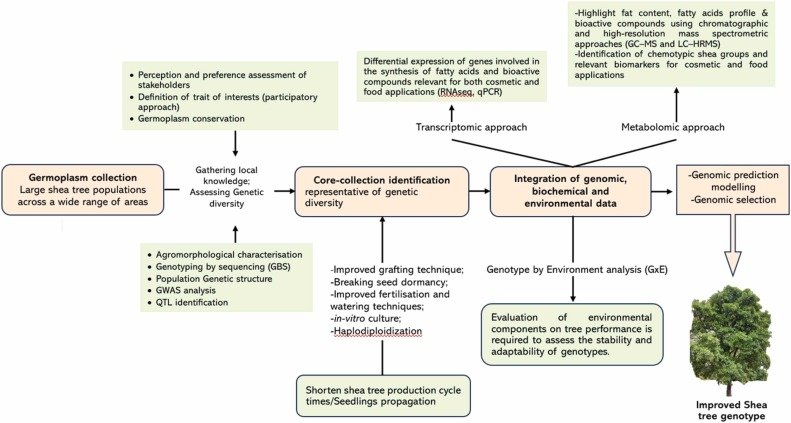
Shea tree (Vitellaria paradoxa C.F. Gaertn.), a semi-domesticated tree in Africa, is valued for its products, particularly shea butter, which represents a multibillion-dollar commodity with growing demand on the international market. However, limited scientific investigations have been undertaken about its domestication and improvement. In this review, we examine the current state of shea tree improvement in comparison to that of oil palm and coconut trees. We analyze its socioeconomic importance and the genetic diversity underpinning selection and cultivar development. The transferability of breeding methods from oil palm and coconut was examined, with emphasis on fatty acid (FA) biosynthesis pathways and associated genes. Insights from these crops highlighted the importance of integrating omics tools, targeting product quality traits, and structuring breeding programs around well-defined selection criteria for the shea tree. Factors influencing FA biosynthesis in the shea tree were also discussed. Beyond FA composition, traits such as specialized metabolite profiles were found to influence butter quality; integrating these as key traits supports a breeding strategy combining genomic selection, metabolite profiling, and environmental data as a concrete pathway forward. Omics tools have demonstrated effectiveness in enhancing oil palm and coconut breeding and could be applied in shea tree breeding. This integrated approach highlights the potential of the shea tree as a strategic resource for rural communities, as well as for the agri-food and cosmetics industries. Applying omics tools previously used in major oil crops to the shea tree opens new perspectives for selecting high-yielding and high-quality genotypes.